中文版
中文版 ENGLISH
 русский
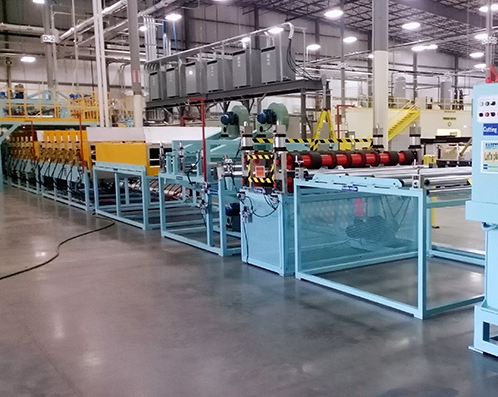
# Professional Selection of Honeycomb Panel Production Line Equipment The professionalism in selecting honeycomb panel production line equipment requires a comprehensive evaluation across multiple dimensions, including demand positioning, core performance, automation level, manufacturer strength, and full-life-cycle cost, to avoid blind followership or price-only decision-making. Below is the detailed professional selection logic: ## I. Clarify Core Demands First to Avoid Waste from Overly Comprehensive Configuration Honeycomb panels are categorized by base material into paper honeycomb, aluminum honeycomb, and plastic honeycomb, with significant differences in production line equipment for each material: - **Paper honeycomb**: Focus on gluing precision and flatness of honeycomb core stretching (suitable for packaging and furniture). - **Aluminum honeycomb**: Emphasize welding strength and cell uniformity (suitable for construction and rail transit). - **Plastic honeycomb**: Evaluate extrusion molding stability (suitable for automotive interiors and logistics pallets). Meanwhile, clarify production capacity (e.g., 50㎡/h vs. 200㎡/h) and product specifications (e.g., panel thickness 5mm–50mm, width 1.2m–2.4m) to prevent overcapacity or insufficient equipment performance. For instance, small-batch customized production can adopt semi-automatic equipment, while large-scale standardized production requires a fully automatic production line. ## II. Focus on Key Performance Parameters of Core Equipment The core processes of a honeycomb panel production line include honeycomb core preparation, laminating and pressing, and cutting, each requiring detailed evaluation: ### 1. Honeycomb Core Preparation Equipment - **Paper honeycomb**: The gluing system must ensure a glue weight error ≤ ±0.5g/m² to avoid degumming or excessive glue; the stretching mechanism shall achieve a cell size tolerance ≤ ±0.3mm for stable honeycomb core structure. - **Aluminum honeycomb**: Welding equipment shall adopt high-frequency resistance welding or laser welding to ensure solder joint strength ≥ 80% of the base material’s tensile strength; the honeycomb core unfolding mechanism shall prevent aluminum foil wrinkling, with a cell verticality deviation ≤ 1°. ### 2. Laminating and Pressing Equipment - **Temperature uniformity**: Surface temperature difference of heating plates ≤ ±3℃ to prevent local poor bonding. - **Pressure control**: Pressure accuracy ≤ ±0.1MPa to avoid panel deformation or delamination. - **Pressing speed**: Match with upstream processes while ensuring stable pressing time (e.g., hot pressing time error ≤ ±5s). ### 3. Cutting Equipment - **Cutting precision**: Diagonal error ≤ ±1mm with burr-free edges. - **Adaptability**: Capable of processing panels of different thicknesses (5mm–50mm) and materials; tool service life ≥ 100,000 cuts. ## III. Evaluate Automation and Intelligence to Improve Production Efficiency Modern production lines shall feature low labor dependence and digital capabilities: - **Automation**: Equipped with automatic feeding, automatic deviation rectification, and automatic stacking systems. For example, automatic deviation rectifiers can control material deviation within ±2mm to reduce reject rates. - **Intelligence**: Functions including real-time data monitoring (temperature, pressure, output), fault early warning (motor overload, insufficient glue), and production report generation. These reduce manual intervention and enhance production stability. Note: Higher automation does not mean better performance. Selection shall align with production capacity and staffing quality. For example, small and medium-sized factories may prioritize a combination of semi-automatic operation and automation in key processes to balance cost and efficiency. ## IV. Inspect Equipment Materials and Craftsmanship for Service Life Equipment durability directly impacts long-term costs: - **Frame**: Adopt high-strength steel above Q235B, with welded parts inspected by flaw detection to avoid deformation. - **Key components**: Press rolls shall be chrome-plated (hardness ≥ HRC55); tools use hard alloys (e.g., tungsten steel); glue applicator rolls resist solvent corrosion. - **Surface treatment**: Equipment surfaces treated with plastic spraying or electrophoretic rust prevention to adapt to humid workshop environments. Request material certificates and process standards for key components from manufacturers to prevent inferior quality substitutes. ## V. Prioritize Manufacturer Strength and After-Sales Service to Reduce Risks 1. **Manufacturer qualifications**: Prefer manufacturers with over 10 years of industry experience and independent R&D capabilities (e.g., patented technologies), and review their project cases (e.g., equipment supplied to renowned enterprises). 2. **Customization capability**: Ability to adjust equipment parameters (width, thickness) per product requirements. For example, producing special-spec aluminum honeycomb panels requires adjusted welding spacing. 3. **After-sales service**: Clarify installation and commissioning period (≤7 days), personnel training (≥2 sessions), warranty period (≥1 year), and quick-wear parts supply cycle (≤48 hours). Some manufacturers offer remote diagnosis for rapid fault resolution. ## VI. Calculate Full-Life-Cycle Cost Comprehensively, Not Just Initial Price Hidden costs of equipment are often overlooked: - **Energy consumption**: Hot pressing equipment accounts for 30% of total energy use; select equipment with energy efficiency level ≥ Grade 2. - **Maintenance costs**: Prices and replacement frequency of quick-wear parts (glue applicator rolls, tools). - **Reject rate**: A 1% increase in reject rate due to insufficient equipment precision may cause annual losses exceeding 100,000 yuan. For example, equipment with a 10% lower initial price but 20% higher energy consumption and 3% higher reject rate will incur higher total costs within three years. ## VII. On-Site Inspection and Sample Testing to Verify Actual Performance Visit the manufacturer’s production line to inspect operating conditions (noise ≤85dB, no obvious vibration), and request sample testing: - **Paper honeycomb panels**: Test bonding strength (≥0.4MPa) and bursting strength (≥1500kPa). - **Aluminum honeycomb panels**: Test shear strength (≥1.5MPa) and flatness (≤0.5mm/m). Samples directly reflect equipment stability and product quality. ## Conclusion Selecting honeycomb panel production line equipment requires full-chain thinking covering demand, performance, cost, and service, avoiding single-dimensional decisions. A professional choice not only improves product quality but also reduces long-term operating costs, building core competitiveness for enterprises.